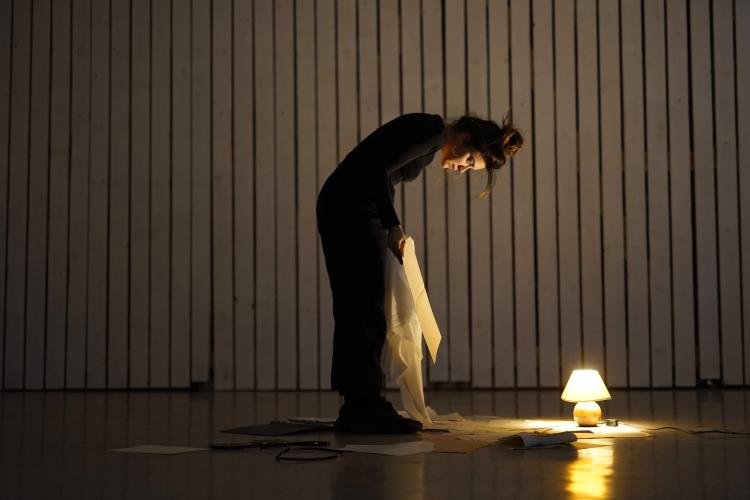


"Social domination entrenches a particular version of history at the expense of those at the bottom of the ladder."
Interview with Lucile Marmignon about her creation "Flo".
Through a work of autofiction, Flo invites us to reflect on how social domination is embedded within our very narratives, to the detriment of the less privileged classes, whose existence is distorted, denied or co-opted. As we become aware of the subjectivity of our memories and perceptions, a desire arises to reclaim history, by rewriting it in the present alongside those who have been excluded from it. In writing the play, Lucile Marmignon conducted research in the archives of public institutions (court cases, court records, testimonies, etc.). On stage, she takes us on an investigation centred on the emergence of possibilities, ready to reconfigure and repair reality. Interview conducted by Pascale Palmers, from the Théâtre de Namur.
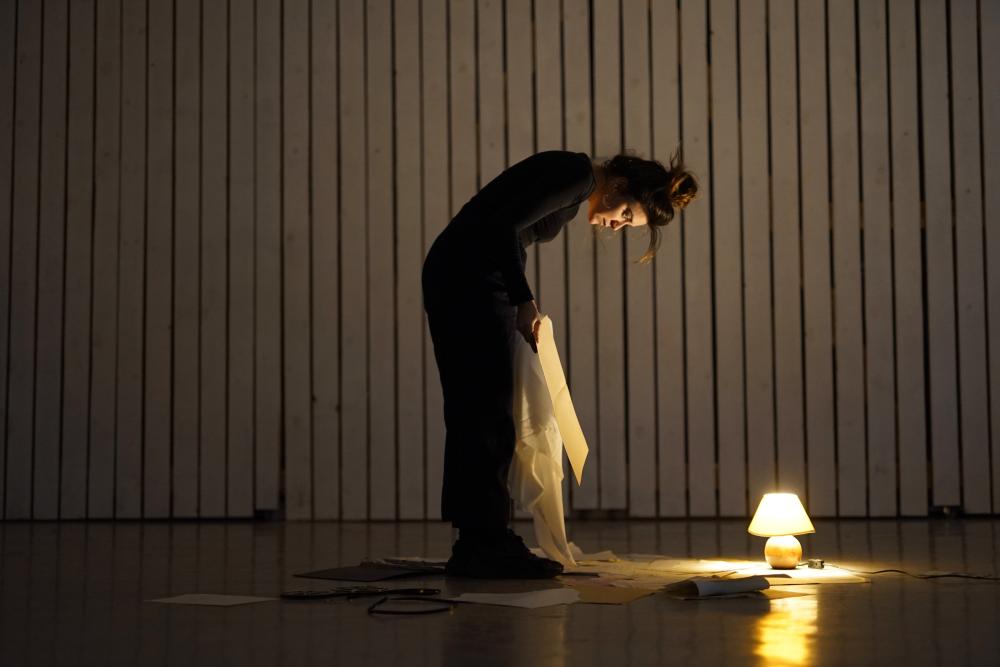
"At first, it was about talking about Flo, trying to get to know her and bringing her to life through my acting."
Flo is the story of your mum (Flo, whom you never knew), your own story, and your dad’s… how does the story begin on stage?
At the start, on stage, apart from me, there’s nothing, just a small light. And just as in the story I’m telling, nothing can exist without Flo, so the first thing is to bring her ‘to life’. The first image of the show is one of a moment of exploration, of trying to act in a theatre to bring Flo to life through a compilation of everything I’ve been told about her. I try to understand who she was, but I soon come to the conclusion that it’s not possible. So a particular Flo emerges from among the others: a Flo who suits me well as a mum, classy with her cigarette and a lovely voice, and it is she who sets the story in motion.
Several scenes follow one after another, each driven by the perspective of a particular protagonist. In the first sequence, my father takes the lead. The scene is joyful and rather idealised. I’m about three years old, my sister is seven; it must be a year or two before my mother’s death, and I imagine how wonderful life must have been, before everything went wrong. I’m inspired by a video of my parents at a party where the atmosphere is relaxed and cheerful, and my father is in high spirits. After that, the memory shifts; it’s the little girls we were who are ‘telling the story’. The atmosphere becomes more mysterious; my parents’ flat grows darker. It’s a time of wandering, of no man’s land; my mother is gone, my father is in a terrible state. And two years later, the judge appears, and we find ourselves in court to discuss the removal of my father’s custody.
From there, you’ll be questioning the ghosts of the past, the forgotten voices, the lost stories, the anonymous characters… what are you looking for in this particular investigation?
Initially, it was about talking about Flo, trying to get to know her and bring her to life through my acting. I also wanted to revisit my family history, particularly my father’s, and portray it ‘differently’ from the way it is described in the archives of public institutions, in the court records where the language used towards him is very harsh. Yet, from my own childhood experience, I have different memories, including funny and beautiful moments too…
One thing led to another, and I found myself questioning the way we represent ourselves and others, our memories, the past… And also questioning how social classes and social domination can cement a version of history to the detriment of those at the bottom of the ladder. So there is a desire to set history right for those who lived through it… but what interests me deeply is the repair of the narrative ‘in the present’: telling the story differently allows us to transform the narrative, to make it unfold in a different way: I am deeply convinced that the words we use to describe things influence the things themselves. In a way, I try to summon the possibilities that could not come to pass but which, if we unearth them, might one day exist. Before becoming an actress, I studied history and have always been interested in historiography—that is, the history of history, ‘how we tell stories’. This has led me to be very attentive and critical of the way in which narratives are enacted.
As for Flo, will she be brought to life through assumptions and fantasies?
It’s a bit of a special case with Flo; she’s the one I have the least qualms about drawing on fantasies for, as that’s all I’ve got to work with! I’ve gathered everything I could find—photos, videos—I’ve asked people to tell me about her from different perspectives, I’ve discovered a whole part of her life (for example, that she was an actress in an amateur theatre group), I’ve met her friends… I try, using all of this, to get closer to her, to put myself in her shoes—but shoes that are entirely imagined and fantasised. As I wasn’t allowed to know her, I call upon Flos who make me laugh or whom I admire. Flo is the central thread of the show (alongside me), but she is multifaceted, she is ever-changing; I like the idea of ‘summoning’ different Flos depending on the scenes and their requirements.
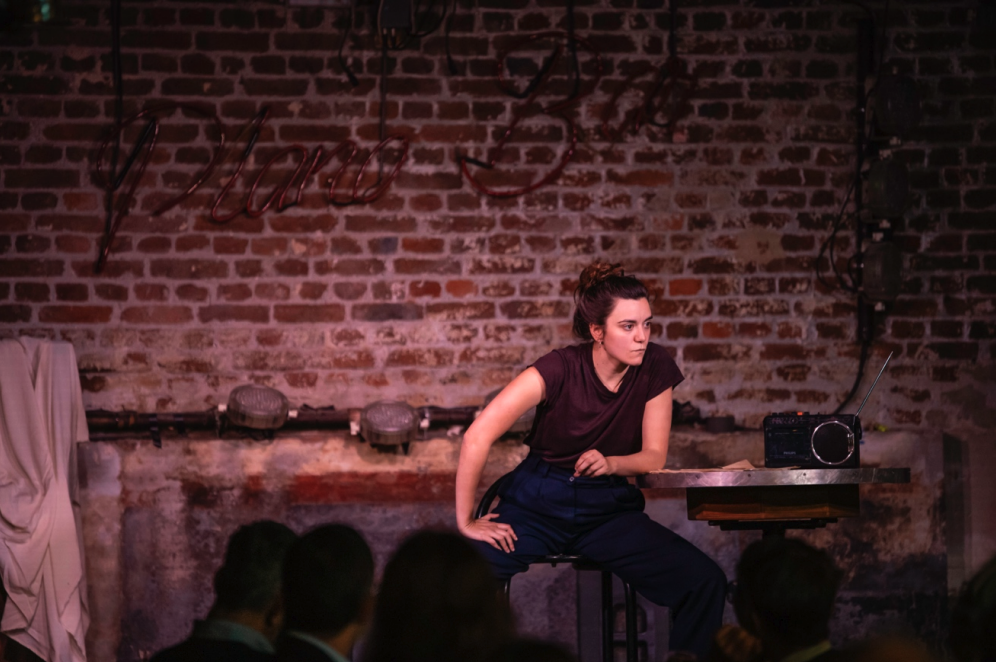
"I draw inspiration from a long tradition of actors, storytellers and creators. There’s a certain affinity with the clownish side of things."
How do you plan to interweave the different layers of the story on stage: archival research, memories, fantasies, and more ‘fantastical’ elements such as the voices of historians or the dead?
The theatrical question—that is, the question of fiction and the acknowledgement that this is a play—is essential, because it is this that allows us to accept this blend of factual elements and more absurd, more strange elements. The beginning is very understated, with memories and real-life situations. Little by little, other things emerge. Such as the appearance of someone who shouldn’t be there at that moment, or historical figures – historians, philosophers… – whom I mention and who intervene in the narrative. The further we get into the story, the more it intertwines with the world of the dead—all the ‘little deaths’ encountered in the archives, for example—and these deaths become symbolic or allegorical figures.
Alone on stage, you’ll be playing a whole gallery of characters…
The question of the character is central. It’s a concept that sometimes seems outdated, but I like to play with conventions and registers, to question the character and the way of embodying them. I’m working on this with Anna Thiriot, who is a playwright, and Laurène Hurst as acting coach. I like to choose broad strokes, pick one or two characteristics and embrace them: ‘here is the character’. It is an admission of the nature of acting, where we do not claim to represent the real, whole person, but rather the symbol they embody or their ‘variations’. I’m also interested in questioning the character themselves: making them wonder, “Am I really like this? Or rather like that?” creates interesting and potentially funny layers of performance.
Then there is a technical aspect that comes into play – especially when there are many characters – for which I draw inspiration from a whole tradition of actor-storytellers-creators. A certain affinity with the clownish side of things (even though I don’t practise clowning in my profession) allows (at least I hope so!) a certain virtuosity in moving from one characteristic to another, from one gesture to another.
What images, what world do you want to create on stage?
I’d like to bring different situations, different worlds, and fully embrace the ‘simple’ power of the imagination and fiction. To create a certain poetry from this imagination – whilst always remaining aware that we are in a theatre, that we are performing – and to gradually bring forth a phantasmagoria of the world of the dead. And the further we progress through the story, the more quasi-fantastic things emerge from the words, the images, the lighting: a costume that suddenly appears, for example, or objects on stage that start to take on a life of their own, like a flickering lamp or a whisper that can be heard, and that these little glitches raise questions and transport us to another world.