


What is the cost of integration? A conversation with Nadine Baboy on "Cultural Disintegration"
10–13 October at the Théâtre Varia
Piecing together the scattered fragments of her heritage, Nadine Baboy presents *Désintégration Culturelle*, a powerful experience that celebrates the richness of her cultural mix. We decided to ask her a few questions to better understand the piece and find out: what is the cost of cultural integration?
Interview by our press officer Sophie Thomine.
Sophie Thomine: Why did you choose the title "Cultural Disintegration"?
Nadine Baboy: The title “Cultural Disintegration” can be interpreted in different ways depending on how you look at it. For me, this title resonates particularly with my personal experience. This show is autobiographical and addresses the issue of cultural heritage and the preservation of one’s culture when living in a country that is not one’s own. I was born in the Congo and have lived in Belgium since childhood. Originally, my mother tongue was Lingala, but when I arrived in Belgium, I had to learn French, one of the country’s national languages, in order to integrate as well as possible. My parents didn’t expect me to end up forgetting my mother tongue.
So the question arises: what is the price to pay for integrating into a new territory, into a host country that is not our country of origin? I had the feeling that my culture was gradually disintegrating, without us even realising it, and the result is that I find myself as an adult, stripped of my mother tongue, because it wasn’t maintained during my childhood. I think my story might resonate with other people. As global citizens, we all find ourselves travelling far and wide, and that feeling of living in a country that isn’t our own, with a culture different from our own, is something many people have experienced. By sharing my story, I believe others can relate to my experience.
A multidisciplinary show
ST: You mention language; you were ‘stripped of your language’ in order to speak French. On stage, you have several means of expression, particularly your body and dance. Could you tell us a bit more about that?
NB: I consider that I have several artistic languages through which to express myself. There is, of course, dance, which uses the body as a means of expression. But there are also words, poetic expressions and even musical composition. It’s a real mix of artistic expressions in this show. The creation of the show really focuses on poetry. It’s truly the central theme of the piece. We develop the dance, music and staging around the poetry. Words and poetry are at the heart of the creation of this show. This show is, in a way, a contemporary take on cultural fusion, not only in the choice of artistic forms, but also in the styles. As for the dance, there is a rather eclectic mix of styles such as hip-hop, traditional African dances, dancehall, house dance, flamenco, tango, and many more. Each discipline represents artistic fusion in its own way.
As for the multidisciplinary artistic dimension, I think there is something for everyone. If someone is more drawn to poetry, words and lyrics, they will be well catered for. The same goes for those who are more drawn to dance or music. I am convinced that the artistic variety on offer allows us to reach a wide audience.
ST: Why did you choose not to have tiered seating and instead allow the audience to sit or stand with you during your performance?
NB: This choice stems from the very nature of how our show was created. The idea for Désintégration Culturelle was born during a multidisciplinary exhibition at the Jewish Museum, organised by a friend who runs the non-profit organisation Mangoo Pickle. One of the performances in this exhibition, called "Close up", took place in a section of the museum comprising several rooms, creating an atmosphere similar to that of a large house. It was then that my friend asked me if I could create a performance combining slam, music and dance. Inspired by the exhibition’s theme, which centred on cultural heritage, I seized this opportunity to create a show that addresses precisely this issue of cultural heritage linked to language.
Thus, from the outset, the show was designed in a way that allows the audience to journey with us. They move from room to room alongside the performers, trying to find their place so they can follow the unfolding story. From the outset, we wanted to break away from the usual conventions by choosing unconventional performance settings. We were fortunate to be able to perform it in different venues, at festivals, whilst retaining this itinerant nature where the audience travels with us and is fully immersed in our world. There is no separation between the audience and the performers. We sought to create a new sense of closeness, a new encounter with our audience. It was also a way of breaking the fourth wall and allowing the audience to truly meet the performers within the performance.
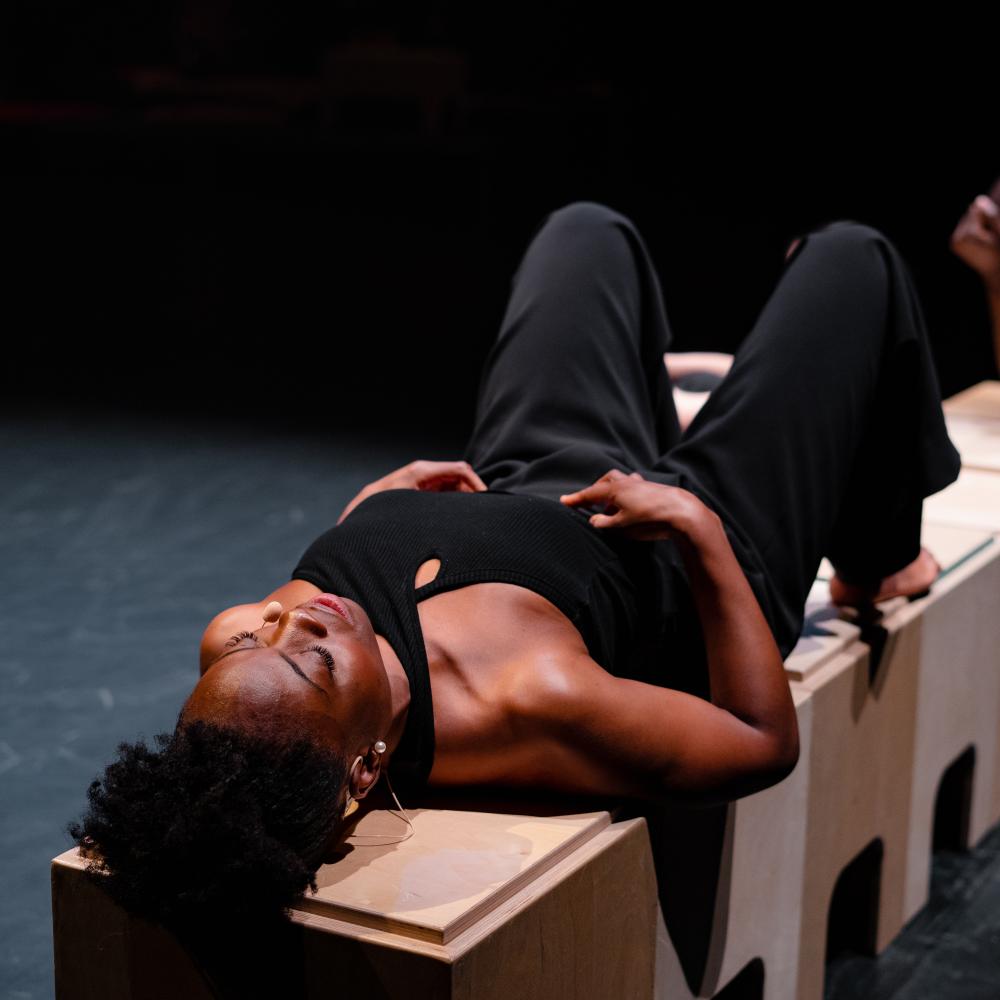
5 on stage: 4 performers and the audience
ST: What was the audience’s reaction?
NB: What stands out first and foremost is how it holds the audience’s attention. Our group of four performers is on stage, and the audience acts as the fifth performer. Every performance is a new experience, both for us as artists and for the audience. Even though the show is the same, we never experience the same performance twice. In reality, we genuinely invite the audience to find comfort in discomfort, and we do the same. As the audience stands all over the stage, with no specific instructions, they sometimes end up in an area or part of the stage that is going to be used. We therefore have to adapt on the spot. The audience helps us create a unique performance.
I would like to emphasise that the audience’s reactions are generally very positive. Some audience members are even deeply moved. Recently, a friend of mine came to see my show and told me that a woman sitting next to her was crying genuinely, touched by my story. What struck her was that this lady was, on the surface, very different from me, yet she was genuinely moved by my story. What’s interesting is that my story, as a woman of Congolese origin living in Belgium, can resonate with people of all cultural backgrounds, skin colours and genders. It really is a story that can touch each and every one of us.
ST: In what way has "The Dancer" enriched your artistic journey?
NB: My involvement in "The Dancer" was an artistic challenge for me. After several years of developing my career in the performing arts, particularly in theatre, it was an opportunity to put my creativity to the test in a more mainstream, televised format. The challenge was to remain true to my artistic identity whilst reaching a wider audience. I think it was an enriching experience artistically, as it allowed me to stay true to myself whilst exploring a different format.
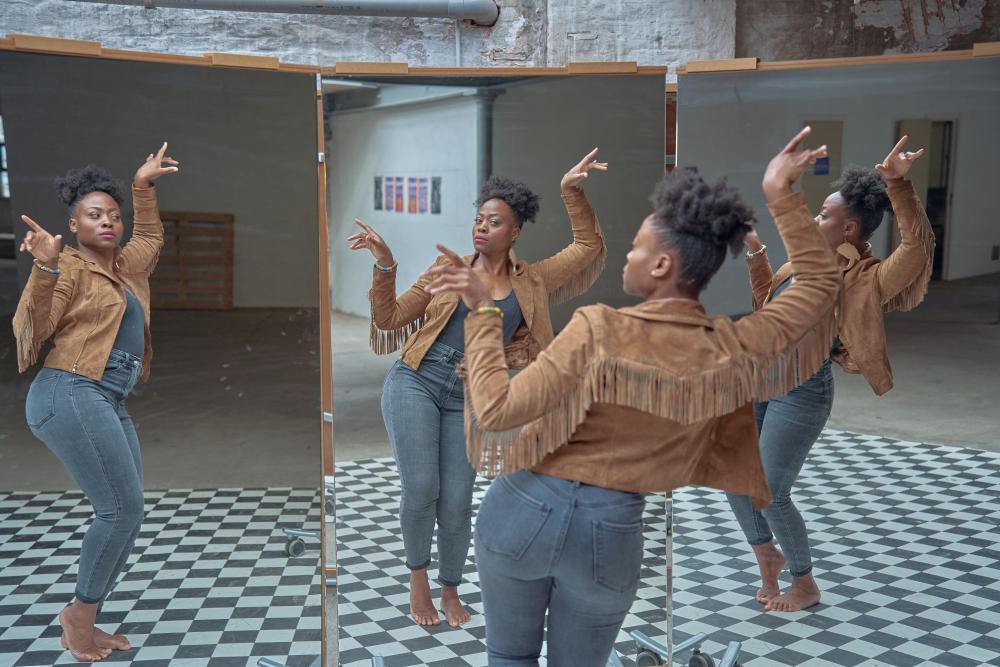
Refocusing on transmission
ST: Are you working on any upcoming projects at the moment?
NB: Yes, I have lots of projects on the go! My upcoming projects are mainly focused on sharing knowledge. As an artist, it’s fantastic to be able to perform in front of an audience, but I also want to share the tools that have helped me grow as an artist and as a person. I’ve created a workshop called “Body Language” which focuses on physical expression. In it, I support people who wish to develop their artistic potential through dance and physical expression. We learn to tell stories through dance, using movement and emotion. I also support artists who wish to improve their physical and stage presence by drawing on the knowledge I have gained through dance storytelling and my journey in the art world. Passing on this knowledge is truly essential to me.
I also have a project where I hope to share my writing. I am currently working on a collection of poetry that I hope to publish soon. It is still in the development stage at the moment.
ST: Is there anything else you’d like to share with us?
As an artist and a human being, my heart’s desire is to pass on and share what I have received with a vision that is far greater than myself. Beyond art, I see myself as a storyteller. I am passionate about telling stories, to inspire others to write their own stories and to inscribe them in the history of humanity with a capital H.