


"Ancora Tu is the story of an actor who shares with the audience the archives of a love story that has just come to an end"
Interview with Salvatore Calcagno about his new production, "Ancora Tu".
The artists Salvatore Calcagno and Dany Boudreault met in 2014. It was love at first sight, both personally and artistically. It was this encounter that inspired a 25-minute piece entitled Sara perché ti amo. Sara perché ti amo has been performed in a number of flats, studios and garages, in places such as Brussels, Paris, Montreal, Limoges and Thionville, for an audience of around ten people each time. Today, Salvatore Calcagno and Dany Boudreault are continuing their project by inviting a new actor to take part in the autofictional retelling of their love story: the Portuguese actor Nuno Nolasco.
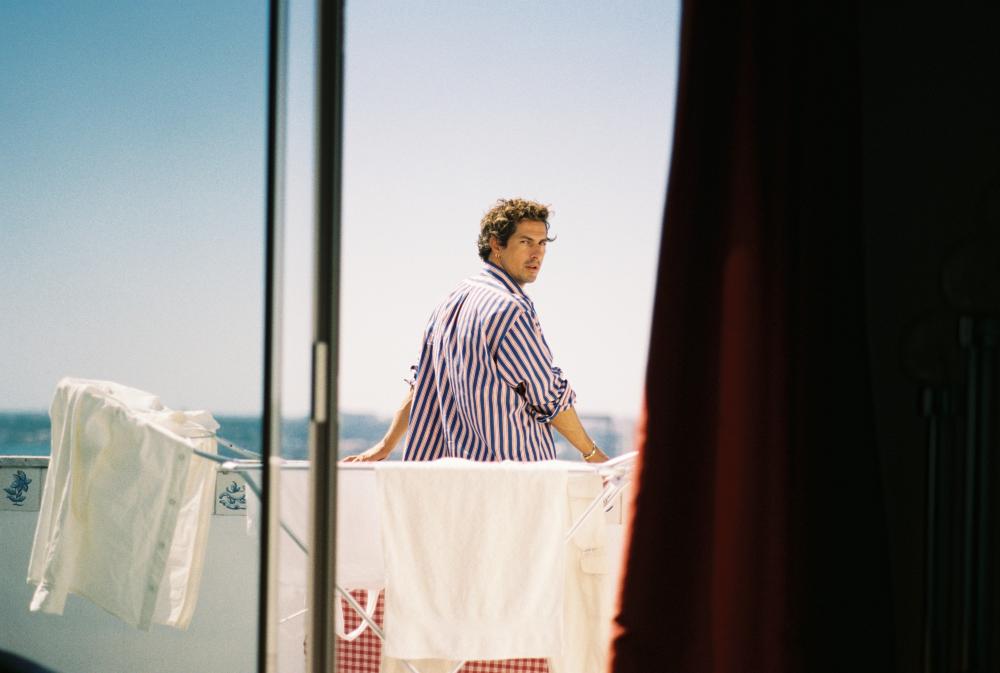
"We have all lost someone, and we have all tried to bring them back to life."
What is Ancora Tu?
It is a performance-based project that I initiated with the writer and actor Dany Boudreault when we met in Montreal. An artistic friendship was born, and we began to imagine a different kind of relationship: if we had fallen in love, what would have happened? This question sparked a fantasy, a very short first performance entitled Sara perché ti amo, which we presented in various spaces (a garage, a hotel room, a flat). Then, we felt the desire to present this story in a theatrical space, and to give a new form to our exploration of performed intimacy.
Today, you’ve invited the Portuguese actor Nuno Nolasco to bring this story to the stage. Why?
I invited Nuno Nolasco to be part of our work because of his sensitivity, his otherness, his imagination, his flaws, his way of loving and living; he brings his desires, his fantasies, his lost loves—past and future—to this exploration. It is this whole personality that embodies the soul of Ancora Tu today. His involvement brings a new dimension and a palette of colours (with the hues of the Lisbon sun and the reflections of the Tagus), as well as a texture of voice and body, and a sensitive perspective on the themes we are exploring through this project.
What themes do you address?
The relationship with loneliness, with abandonment, in the face of love, family, and friends. And in that abandonment, how are we looked upon? How does the gaze directed at us ultimately give the feeling of not being abandoned or lonely, but rather accompanied. This connection through the gaze is very much present in Ancora Tu.
In what setting does this interplay of gazes take place?
An apartment. This realistic setting is the vessel for the romantic passion of Ancora Tu. The realism of this apartment does not physically exist on stage, only through fragments of sound (audio archives played in the foreground) and visuals (photographs integrated into the set design). These elements are reminiscences of a place that exists in real life: Rua de São Mamede in Lisbon. It is a place where I have experienced intimate stories (romantic and friendly). I drew inspiration from it to write the fiction with Dany.
How do you ensure that this autofiction is not merely a ‘sublimated withdrawal into oneself’*, but establishes a universal connection with the audience?
Ancora Tu is the story of an actor who shares with the audience the archives of a love story that has just come to an end. This love story becomes a story of absence, of mourning. From the very start of the performance, a pact is formed between the performer and the audience: we are going to bring this beloved and departed person back to life, one last time. It is in this re-enactment* that Ancora Tu becomes universal: we have all lost someone, whether through death, the end of a friendship or a romantic relationship, and we have all tried to bring them back to life. Theatre exists precisely to enable this magic and to release the tension of memory. Roland Barthes describes this imperative to break free very well when he says: “the lover who does not forget sometimes dies from excess, fatigue and the tension of memory.”
*“sublimated withdrawal into oneself”: Annie Ernaux, Le Vraie Lieu
*Reenactment is a performative method involving the recreation of certain aspects of a past event, a historical period or a way of life.
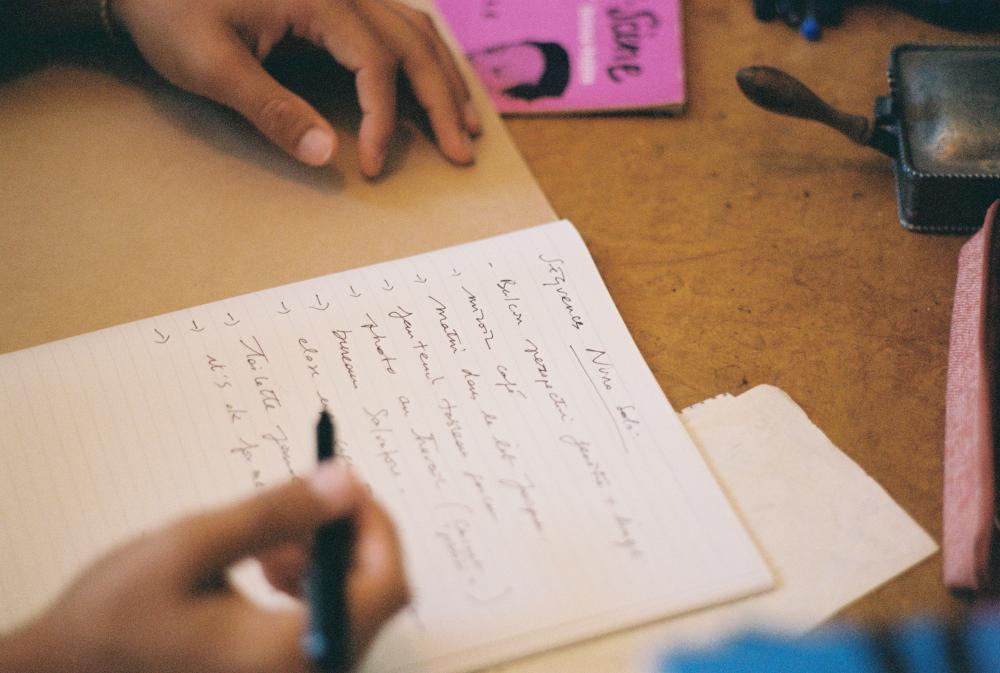
"With this intimate aesthetic, you can venture out and explore new frontiers."
The theatrical form of *Ancora Tu* is that of a portrait. You are, in fact, known for this kind of composition. How do you go about it?
In portrait work, the interplay of gazes between the actor and the audience is important. This interplay of gazes (a wink, a mischievous look, a posture) allows the actor to decide how they wish to be viewed and, above all, to agree on the fiction we are going to experience together. With Ancora Tu, creating an immediate intimacy between the audience and the performer is essential so that the audience feels they are entering an intimate, documentary-style portrait, stepping beyond the fourth wall, even though all the conventions are there to say, ‘no, we are very much in the theatre’. This happens in the first few seconds, the first few minutes; it’s very subtle.
How does this portrait unfold from there?
Through the aesthetic that emerges from the personal archives. This aesthetic is also present in the formal language of the text, in the movements of the choreography and the musical accompaniment.
What are you seeking to achieve with this aesthetic?
I’m seeking a distance that allows for the arrival of theatre, beauty and fiction. With this aesthetic of the intimate, you can venture out and experiment with boundaries. In the context of Ancora Tu, these lie in the sexual, the pornographic, the obscene, shame, violence, and the pathetic.
What is your definition of the pathetic?
The pathetic applies to Ancora Tu to define the performer’s physical and emotional momentum; all that strength, those laughs, those tears; that urgency to relive one’s love story one last time, at any cost, with the audience.
Ancora Tu is the story of a queer love. Why is it important to you to bring this story to light today?
We live in an age where expressing queer love in the street or online means exposing oneself to a range of violence. We talk about this in the performance—this everyday violence, this knot of fear in the stomach—because today there are far more queerphobic attacks on the street than there were 10 years ago, not to mention digital harassment as well. The spaces where people are exposed and their lives threatened have multiplied today, as have the outbursts of violence.
Does that feed into the importance you place on the portrayal of characters?
Yes, representation is now a major issue in theatre. I’ll always remember the time Dany and I performed the first version of Ancora Tu in front of a school audience steeped in religious culture. Those teenagers were both shocked and moved by our play. And that’s when I thought to myself, we’ve won; emotion trumps constructs and beliefs. Emotion is political.
How do these representations develop in your work in general?
By including marginalised people in a narrative that isn’t solely focused on their ‘differences’. A narrative in which their presence is no longer a subject in itself, but where they are there to bring the plot and situations to life. This also avoids the pitfalls of ‘fetishising’ the stories.
The plays you’ve directed (La Voix Humaine, A Streetcar Named Desire) draw on the camp* repertoire. What specifically attracts you to these works?
The cult of the character, an ‘ultra-theatrical’ aspect, through the dialogue, the costumes, the way they are portrayed in the narrative; these elements trigger very powerful visualisations for me. These are nuanced characters: caught between fear and hope, between a need for freedom and vitality and darker inclinations. There is a special power in these texts, linked to the themes of love, desire and sexuality, like an existential and revolutionary force over which power (be it political, economic or ideological) fails to exert control.
*Camp is a style, a form of artistic expression. The camp aesthetic plays on exaggeration, the grotesque, provocation and humour. It emerged as a significant cultural sensibility in the 1960s, at a time when the conservative right dominated. The camp style is also described as a perspective specific to the gay male subculture, and the queer community in general.