


"It would be nice if we had a bit more say in how we say goodbye."
A conversation with Marie Lecomte about her new work, "Feu les animaux"
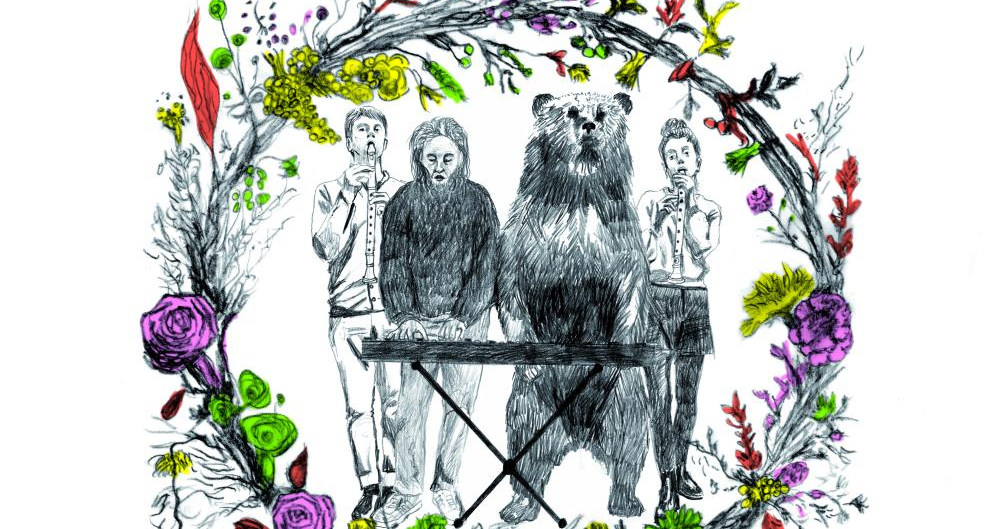
Through the mourning of wild and domestic animals, big and small, Marie Lecomte’s cheerful troupe seeks to find ways to do just that: a musical show exploring our rituals surrounding death, *Feu les animaux* is an invitation to celebrate it in a different way. An interview conducted by Sophie Thomine.
"I often find myself wondering about the place of death in our Western societies"
*Feu les animaux* is a show for young and old alike, exploring death and our funeral rites. Why did you decide to tackle this subject in this production?
I often wonder about the place of death in our Western societies, or rather its ‘non-place’. All too often, we push it as far away as possible, rushing through funeral ceremonies in a very short space of time. Yet I believe ritual is fundamental to the grieving process, so that those left behind can come together to ‘do something’, as is so naturally practised in other societies. This line of thinking led me quite naturally to write a show for children, for whom this subject is far less taboo than it is for adults.
For this production, you researched funeral rites in various countries extensively; what did you learn from this? Did it inspire you for *Feu les animaux*?
The team and I started by watching ‘Des morts’, a cult documentary by the Belgian filmmaker Thierry Zéno; it was an incredible insight into rituals that are very different from our own. In many places, people are physically close to the dead; they talk to them, take them for walks, and ‘bring them out’ every year. I also did a lot of research online; I was particularly struck by funerals in Ghana, which take the form of huge celebrations where the coffins are decorated and personalised according to the tastes of the deceased. Some are shaped like aeroplanes, pineapples, birds, cars, and so on...
In *Feu les animaux*, although I was influenced by all my research, I wanted the protagonists to invent their own rites, seeking, with the limited means at their disposal—that is, through music, words and dance—to pay tribute to a being who once was and is no more. How can we forge, from the models presented to us, our own rituals—ones that will do us good?
"Even though we’re aiming at children, we don’t make music for children"
Music is an integral part of your theatrical creations. Tell us about this hybrid nature that defines your artistic identity.
I don’t come from a musical background, I’m not a musician, but in a completely intuitive way I’ve always incorporated live music into my shows. It’s as if it brings a sense of mystery and emotion that words cannot convey, as if it gives access to another, more instinctive, less intellectual part of us—or of me, at least. I sometimes get the same feeling when visiting an exhibition; the emotion that washes over me can overwhelm me intensely, stimulating very different parts of my brain. I love this blend of theatre and music; I also like not being pigeonholed: is it a concert or a show? It doesn’t really matter, actually; what counts is that it reflects who we are, and that it’s sincere.
What role will music play in Feu les animaux?
There’ll be music pretty much all the time! Or rather, different kinds of music, as we’re venturing into lots of different styles. The requiem theme will be present at the start, played on a variety of instruments (from keyboards to mini-synths, drum machines, electric guitar, recorder, likembé...) and gradually set aside as the protagonists realise that funeral music can be more than just sad. Our influences include Purcell and Mozart for the classics, but I’ve been greatly inspired by Laurie Anderson, Pierre Bastien, Paul McCartney and even Kraftwerk for the compositions. We move between rock, electro, and traditional African, Corsican or Mexican music.
In any case, even though we’re performing for children, we don’t make ‘children’s’ music; I actually think children can easily listen to the same music as their parents.
What would you like the audience to take away from your show?
That you can talk about death with children, that you can even draw inspiration from their reactions, and that they are far less afraid than we are. Talking about death through the lens of ‘unknown’ animals allows us to approach this subject in a slightly more detached way than when it comes to the death of a pet or a loved one. And I hope it then leads us quite naturally to talk about ‘our’ own deaths.
And then, if we could tell ourselves, as with everything, that there isn’t one right way to do things, no set formula for a funeral, but that what would be nice is if we could choose a little more how we say goodbye.