


"Sisterly support is the future of feminism."
An interview with Penda Diouf and Silvia Costa about their new production, "Sisters, our forests too have thorns".
Penda Diouf and Silvia Costa blend different time periods and dreams in a story of a deeply close sisterly bond. As a break-up looms, memories—both real and imagined—resurface and fracture the family narrative. Created as a touring production by the Comédie de Valence, Soeur·s, nos forêts aussi ont des épines is coming to the Varia from 24 to 30 January.
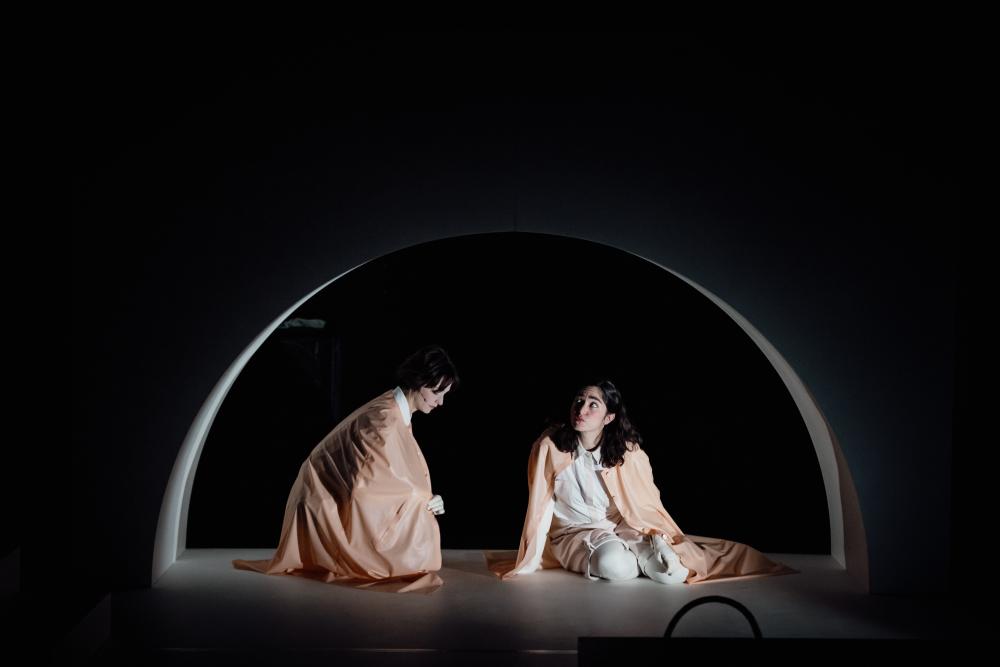
"She told me she wanted to talk about sisterhood. For her, it was an ideal to strive for, but society did not encourage solidarity among women."
How did this collaboration come about, and where did your respective artistic worlds converge to give rise to this joint project?
Penda Diouf: Silvia and I are both members of the artistic ensemble at La Comédie de Valence. But we’d never really had the chance to talk. It was Claire Roussarie, deputy director of La Comédie de Valence, who suggested I work on a text for Silvia, and I agreed straight away because I was curious about her world. So Silvia arranged to meet me before the performance of Pascal Rambert’s Trois annonciations, in which she was appearing. She told me she wanted to explore the theme of sisterhood. For her, it was an ideal to strive for, but society did not encourage solidarity among women. Then Silvia told me about a dream in which she was walking through the forest and suddenly her sister appeared, hidden in a tree. I asked her if she could draw a picture of that encounter for me. That’s how the collaboration began.
Silvia Costa: Meeting Penda was very inspiring from the very first moment. I felt a connection and an understanding that led me to share with her my experiences of collaboration between women—which can sometimes be complex—or the one I’ve personally experienced with my sister... I felt that with her I could find a poetic and narrative form to explore, through questioning, the concept of ‘sorority’ – a term that does not yet truly exist in everyday vocabulary.
In this story, the relationship between the two sisters oscillates between love, solidarity and tension. How do you explore this duality, both in the writing and in the direction?
Penda Diouf: I wanted to tackle the complexity of the sisterly relationship. You can be from the same family and not get on at all, have diametrically opposed personalities. Your place in the family also plays a part, whether you’re the eldest or the youngest. I wanted to follow these sisters at a specific moment: a walk in the woods just before the younger sister leaves for abroad. An opportunity to put their relationship back at the heart of things, to bring unspoken issues to the surface and ask the questions. To start afresh for a new beginning in the way they relate to one another.
Silvia Costa: In our early discussions, we often spoke of creating different dimensions during the performance, one in the present, concrete and realistic; a second, altered like a dream, where memories emerge like a stream of consciousness; and a third that speaks to the universal, which, like a cry for help or a magic spell, can bring all women together—a sisterhood that transcends blood ties. I therefore sought to highlight this shift in state through the different scenes, by emphasising their division. I sought a distinct character for each one that could guide the audience on this textual journey, rich in imagery, information, connections between elements, but also in emotions. And above all, I sought a balance between text and symbol, gesture and speech, information and image, by highlighting a divergence between what we hear and what we see.
Water features frequently in the text (amniotic fluid, drowning, the planet’s composition). What role does this element play in the bond between the two sisters?
Penda Diouf: I’m reminded of a quote by the philosopher Simone Weil: “Let us love this distance that is deeply woven with friendship, for those who do not love one another are not separated”. Water is the element of distance: the mother and the unborn child, the continental plates on the planet. But it is also an element that carries memory. The body is 70% water. How might this emotional energy influence the characters? How, through contact with it, are the two sisters’ memories reactivated, revisited to be laid bare and perhaps find answers as well as a form of solace.
Silvia Costa: As with fish, water is the environment in which these two sisters are immersed, the invisible force that surrounds them. I therefore sought to render this element on stage in various forms: the white latex of the costumes, a stick filled with water, whose air bubble allows us to visualise a wave, the seesaw, whose swaying evokes the movements of a boat, and the percussion in the music, which sets the air vibrating.
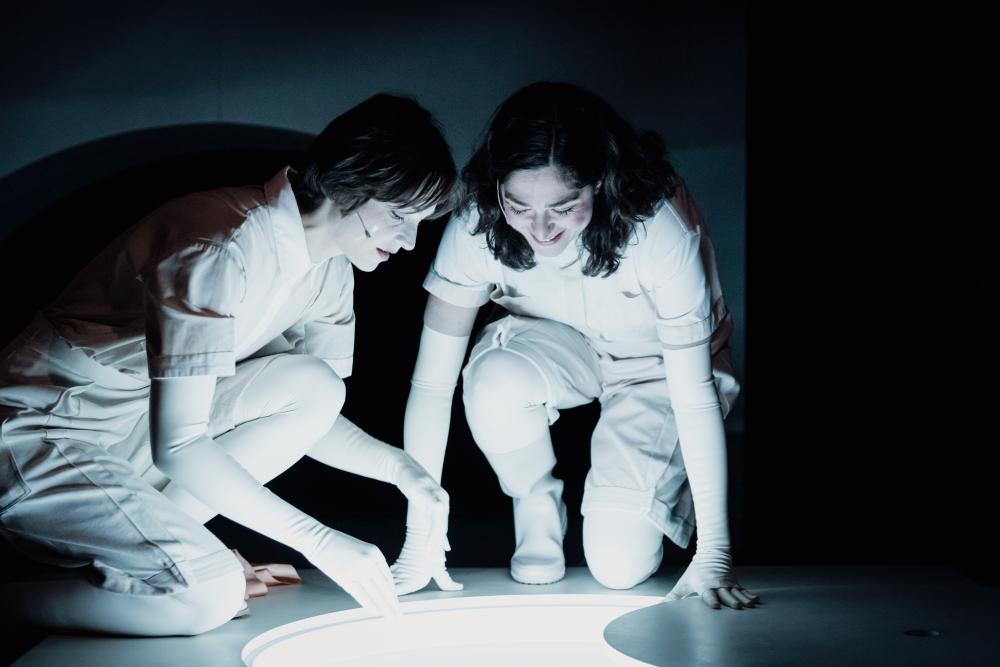
"The writing has been adapted to the three movements of the play: reality, memory and the choral form."
What do the different temporalities—reality, dreams and memory—allow for? How did you go about ensuring they coexist on stage?
Penda Diouf: I like there to be a sense of fluidity between these different temporalities, so that we’re no longer quite sure where we are, or how much time has passed. It creates a sense of disorientation through the loss of bearings, which allows us to shift our perspective or step outside ourselves.
Silvia Costa: The different temporalities allow us to shift states and physical dimensions, and so they shape and sculpt the stage time. Penda’s text dictates this staging because the action that drives the story forward is, in fact, time and memory.
Music seems to play a major role in the production; how does it contribute to the narrative?
Silvia Costa:For this project, I decided to work with the composer Sandro Mussida. His musical approach is closely linked to the show’s dramaturgy; he connects sounds with a character’s personality. It’s tailor-made sound. I feel that the music really alters the atmosphere in the theatre; it’s the air the actresses breathe.
Is this musicality present in your writing?
Penda Diouf: Perhaps the writing has adapted to the three movements of the play: reality, memory and the choral form. This creates different rhythms. The first part features a somewhat classical dialogue. Then there are longer, more narrative sentences in the dream sequence. As for the choral form, it consists more of poetic phrases, in the style of a manifesto. These different rhythms create musicality and breaks.
What, in your view, makes this exploration of sisterhood universal?
Penda Diouf: I wanted to create connections vertically, through the lineages of women. But also horizontally between women of the same generation. As these two axes intersect and create connections, the characters are at the intersection of these lineages.
Silvia Costa:When I suggested to Penda that we work on the sisterly relationship, I had a desire to address relationships between women in general – where one expects a helping hand to support one another, yet instead finds a cold shoulder. This is a sign that in society, our struggle to “earn our place” remains a sensitive issue. We always speak of “a woman” or “the wife of”, rather than a group. I felt that I had suffered greatly in my life because of this competition that weakens us. So in this text, there is indeed a movement towards openness: starting with two sisters, we expand to a third, and then to the women who came before them and the women present in the room... This text invites us to reach out, it calls on us to join others, to act together, to form a group. Sisterly support is the horizon of feminism.