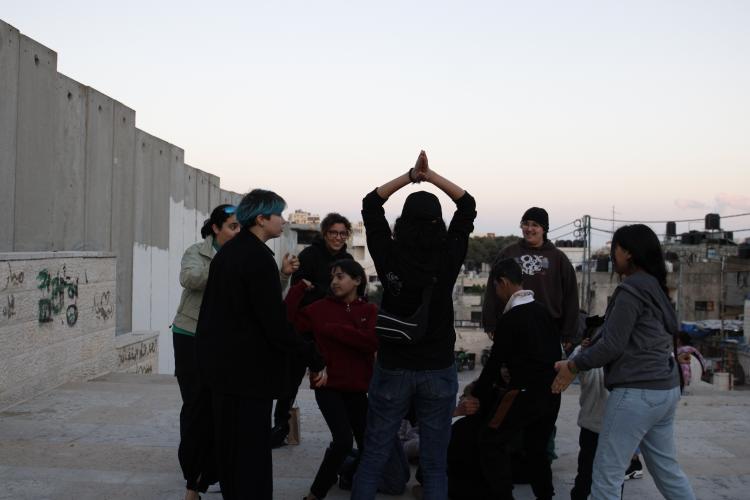


"An amâna is a trust, a promise, a word, a commitment."
Interview with Monia Gandibleux about "Amâna"
In May 2023, after reading Colum McCann’s book *Apeirogon*, a group of young people from Brussels, members of the Ambassadeurs d’expression citoyenne, decided to travel to Palestine. They wanted to meet people, gather stories of resistance and understand the role of silence there. We meet Monia Gandibleux, the project leader, coordinator and founder of the Ambassadors.
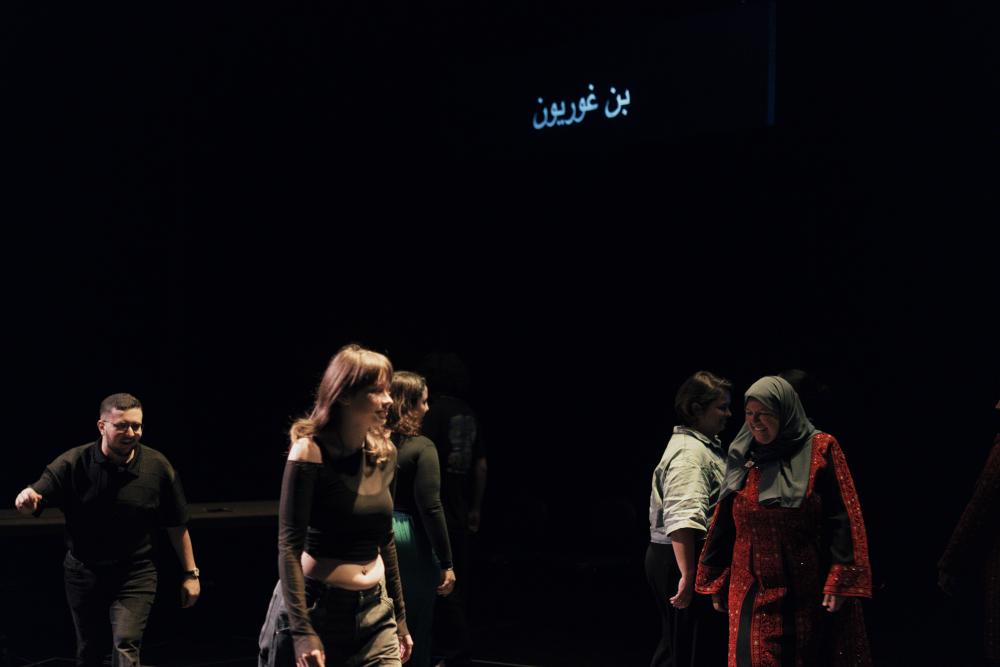
"We have come to realise that empowerment is not just about words, but also about action."
You are the founder and general coordinator of Les Ambassadeurs d’expression citoyenne, the organisation behind Amâna. Can you tell us what you are and what you do?
The non-profit organisation Les Ambassadeurs d’expression citoyenne was founded in 2017 with a core mission: to empower young people through civic engagement. In response to the feeling of invisibility experienced by many young people, we have created spaces where they can tell their stories, claim their place, and use dialogue as a force for change. Through debates, meetings, and artistic or activist projects, we provide them with the tools they need to make their voices heard.
Over time, our mission has broadened, without ever losing sight of this cornerstone: the power of speech. Reconnecting people with their voices is what builds society.
We have come to understand that empowerment is not achieved through words alone, but also through action. That is why we also work on the concepts of accessibility (cultural, educational, sporting, media, etc.), and develop projects centred on social inclusion, international and European issues, the ecological transition and living together. Generally speaking, active involvement fosters commitment to causes close to their hearts (the environment, the rights of undocumented migrants, decolonisation, support for the Palestinian people, etc.), always with the intersectionality of struggles as a backdrop. We want to “work for and with” rather than “act against”. One of our objectives is to build a collective, whilst respecting everyone.
All our projects aim to create spaces for participation, learning and transformation, driven by and for young people.
We mainly target young people aged 15 to 30, living in and around Brussels, who are all too often faced with economic, social or cultural barriers. Some have been stigmatised, defined by their background, sometimes alienated from institutions, and often undervalued in terms of their potential.
Our work reaches an extremely diverse audience: secondary and higher education students, young people who have dropped out of school, young workers, young people of colour, those from migrant backgrounds, LGBTQIAP+ individuals, refugees or undocumented migrants, and so on.
This project began with a trip you took with Les Ambassadeurs d’expression citoyenne. Why did you choose to go together?
After numerous trips to the West Bank, always accompanied by young people from very different backgrounds in Brussels, it seemed obvious to me at one point to set off (again) with the Ambassadors.
Why? Because on previous trips, despite our constant effort to be nuanced, by meeting people on both sides (Israeli and Palestinian), all driven by a desire for peace and respect, something essential was missing: space for Palestinian narratives.
Every time we gave time to the Israeli narrative, it was time taken away from Palestinian voices. And this contributed, despite ourselves, to the normalisation of the imbalance in the narratives. The Israeli narrative is so dominant, so overwhelming, that we always end up letting Palestinians speak in reaction, as if in response, rather than in their own right. And that creates a feeling of suffocation.
So I felt a strong need to really listen to the diversity of Palestinian voices. Because this narrative is not monolithic: it too is made up of nuances, contradictions and complexity. It deserves our attention; it deserves to be explored in depth, in all its diversity, through the different realities of the West Bank.
And I chose to go there with Les Ambassadeurs because I know this group is capable of listening with attention, humility and a critical mind. They adopt the stance of allies, which allows them to receive a story without betraying it, without simplifying it. They also have the tools to understand the context (historical, political and human), to decipher the silences, the tensions, and the implicit narratives. Above all, they possess the maturity required to navigate collectively through a deeply unstable landscape, without succumbing to a naïve or purely emotional response to the situation.
It is this confidence—in terms of knowledge, attitude, sensitivity and collective intelligence—that led me to make this choice.
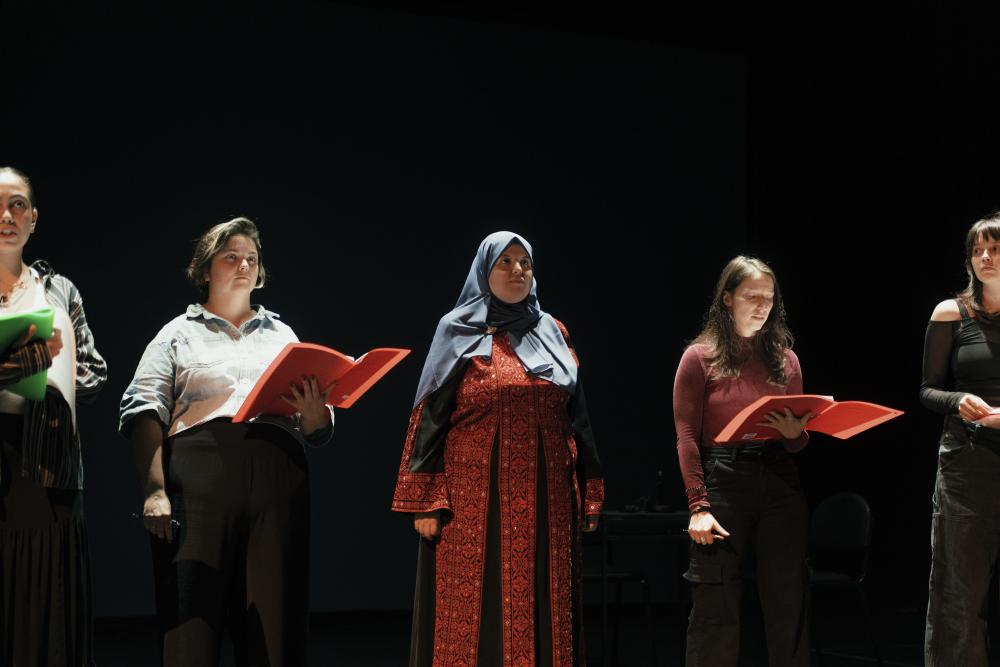
"Right from the outset of the project, the question of silence has deeply affected us all."
In the West Bank, you met many Palestinians. What inspired you to bring their voices to the stage?
What we received there was an amâna, a precious trust, a responsibility. The very fact of having been welcomed into their daily lives, into their thoughts, their relationship with resistance and commitment, immediately made us feel that these words could not remain within us, unspoken. We had to do something with it. Long before 7 October, this project was built on this conviction: we are not passive witnesses, but messengers.
And we knew it was risky; any translation is a form of betrayal. So we asked ourselves: how could we convey as faithfully as possible what we had perceived, heard and felt? Knowing in advance that it would be partial, inevitably incomplete, that we would never fully do justice to what had been entrusted to us.
That is why it very quickly became clear that their own voices had to be present alongside ours. So that the audience could hear both how we, as Europeans, according to our own sensibilities, received these words, and how they, as those most directly affected, convey them directly, without a filter.
That, too, is what it means to be an ally: speaking alongside them, never in their place. Sometimes we are tasked with conveying their message, but only for a time. And as soon as it is possible to let their own voices be heard, then it is our duty to create that space. What matters just as much is that their words are not isolated on stage, but carried, supported and reinforced by our presence, our listening and our commitment. That they feel the full force of a sincere alliance.
Amâna focuses on the issue of silence. How did you observe it?
From the very inception of the project, the question of silence has deeply resonated with us. We are an organisation that works around speaking out, but always in relation to silence. For there is no speaker who has not first confronted their own relationship with silence, who has not tamed it. Silence is an ally.
When it is imposed, it can muzzle. And most of the people we work with have, at some point in their lives, been silenced. This has left its mark, created cracks. Initially, we had to relearn how to speak, to release words that had long been held back. Then, in a second phase, we had to reacquaint ourselves with silence. No longer as a form of censorship, but as a space of calm, of breathing, even of power.
Once this work had been accomplished here, internally, we gained a better understanding of the significance of silence over there, in the West Bank. We then wanted to meet people (both in the north and the south) who experience this relationship with silence in very different ways. Some fight it head-on, engaging in a marathon of storytelling to make the Palestinian narrative heard more and more, such as PalVision in Jerusalem.
Others, on the contrary, have chosen to make it a radical ally, expressing themselves solely through the body, such as Palestinian Circus or Alrowwad. Their observation: certain words no longer get through. They have been undermined, hijacked, worn out. So they say: “We will no longer speak amidst the noise. And through this silence, we will let you see our bodies, our realities.”
And then there are those who look beyond words, into the very substance of things: the earth, the seeds, the living transmission. Like the seed bank in Hebron. Another way of telling a story. Another way of making oneself heard.
At first, we almost thought we wanted to put silence on trial. But in fact, is it really silence that we should be accusing? If there is a problematic silence, it is not the one experienced over there. It is the one playing out here, in Europe. A silence that sticks to the skin, and we’ll struggle to explain it to future generations… a persistent shame. And even when certain words are spoken, they have that terrible taste of ‘too little, too late’.
You work in particular with a Palestinian company, the Alrowwad company. How did you meet them?
We met the Alrowwad company a few years ago. This centre is located in the heart of the Aida refugee camp, one of the oldest, itself enclosed within the city of Bethlehem, a Palestinian city also surrounded by that infamous wall with a thousand names.
Alrowwad was born out of this context of forced isolation, and strives, through art and what they call ‘joyful resistance’, to restore meaning to the lives of young people growing up in the camps, not only in Aida, but also in those in the surrounding area.
The values underpinning this place—namely emancipation, solidarity, transmission and dignity—are values we fully share. Alrowwad does not merely teach; it forges connections, builds networks and restores pride to a Palestinian youth that is often vulnerable. When you step into this centre and see how it operates, you can’t help but want to give it a platform here in Europe, so that this reality can be seen, heard and recognised.
We stayed in their “guest house”, located right in the heart of Alrowwad, at the centre of the Aida camp. It is not simply an arts centre: they also have a carpentry and joinery workshop in the basement, amongst other activities. It is a vibrant, multifaceted place, deeply rooted in the daily life of the camp.
And this stay gave us, however briefly, a glimpse of this reality: the military raids at dawn, the tear gas, the constant pressure. But also, the incredible way in which the residents turn violence on its head: tear gas canisters salvaged and transformed into jewellery, as a symbol of resilience, creativity, and “active dignity”.
Alrowwad embodies all of this. In my view, it is the perfect place to illustrate what we are trying to convey here.
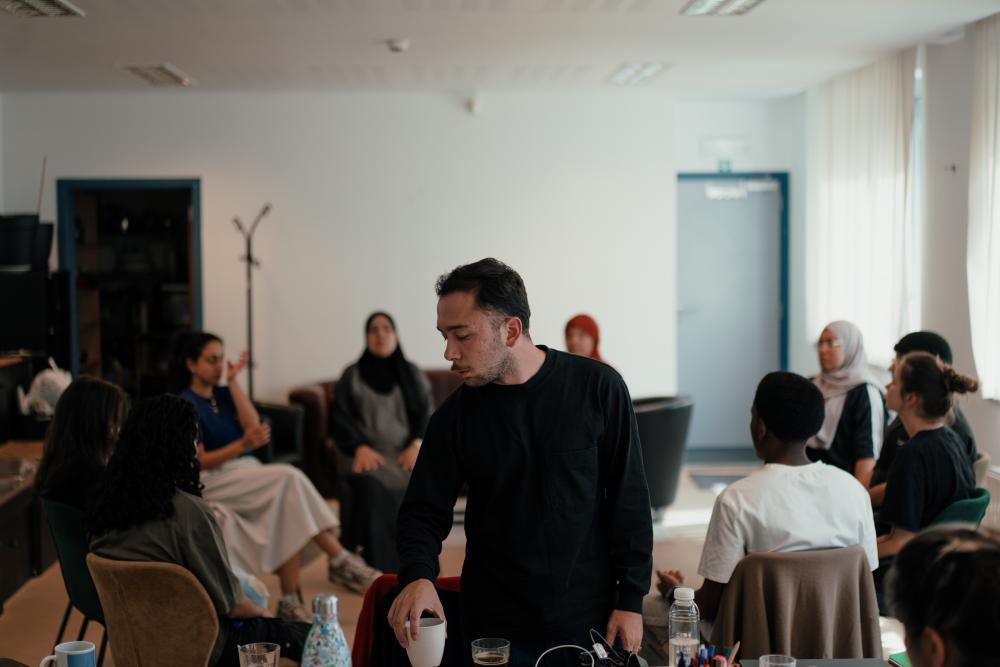
"In fact, we skirted the world of theatre for a long time, moving along its fringes and taking detours, before finally stepping fully into it."
At Les Ambassadeurs, you’re used to speaking in public but not necessarily to performing on stage or to the art of playwriting. How did the process of getting to grips with it go for you?
Public speaking is an art. Even though it should be a basic skill, when honed, it becomes a true artistic expression. We approached the art of the stage in small steps. Through slam poetry, open mic nights, and above all through work on the body, on presence, on finding the right word. In fact, we skirted the world of theatre for a long time, along the fringes, taking detours, before fully entering it. We explored the power of the collective, the idea of a troupe, the ability to convey a message, to tell a story together. Little by little, all these elements have led us here, onto a stage, with a powerful theatrical piece. And ultimately, it all fits together perfectly.
Coline Struyf, the director, puts it very well: if one of Amâna’s objectives is to make things happen, if a few people in the audience feel something shifting within them, then we will have succeeded. But that is not all. If our Ambassadors, by taking to the stage alongside the Palestinian actors, form a real troupe, then we will have won. If this troupe discovers the power of the spoken word on stage, and everything that a venue like the Varia represents, then that is an additional victory. Because every time we value a young person’s voice, every time we place it within a framework that respects it and listens to it, we are contributing to a form of healing. And this healing is essential, in the face of institutional barriers and the silent violence that society inflicts on its own young people. And if these voices, as well as healing those who speak them, manage to reach a new audience, far removed from our usual circles, then a bond is forged, and that is yet another victory. This meeting between Les Ambassadeurs and the Varia stage therefore holds great promise. It is the fruit of a journey, of progress. And today, the stages are joining forces: the troupes, the venues, the institutions, united by a shared commitment to free speech, to dignity, and to a certain vision of democracy and reconciliation.